Showing posts with label organic. Show all posts

Wednesday, May 4, 2022

A new Zealand walkaround in London


A fun day tasting New Zealand wines, expertly organized by Sarah Shepherd and Chris Stroud of NZ Wine. A large gathering with a wide range of products. 

Here below are some of the gems that I thought were most worth taking note of. I surely missed many more as one day was just not enough to do justice to this great event: 270 wines, over 20 styles, and a special section dedicated to organic wines which reserved a few gems for us. 

Indicative RRP in GBP.

Click on the vineyard's name to link to their websites.

Akitu

Akitu pinot noir blanc 2021
Pinot noir 100% vinified as white wine, with only a shade of pink to betray the original red grape. Citrus, almonds, good balance and mod length. A pleasant surprise. GBP 42, not cheap. Score 88

Akitu A2, pinot noir 100%
A good simple pinot noir, a bit expensive at GBP 31.
Score 85

Akitu A1, pinot noir 100%
A more complex variation of this noble grape. GBP 31
Score 86

Craggy Range

Craggy Range Aroha Pinot noir 2019
A complex wine which is surprisingly mature already. GBP 75
Score 92

Craggy Range Le Sol Syrah 2019
Also amazingly ready to please the taster, GBP 75
Score 92
Craggy Range Sophia Red Blend 2019
60% Merlot, 26% Cab franc, 14% cab sauvignon. 
The least interesting of the top three, it is anyway a very successful blend with a round body, also ready now. GBP 75
Score 89


Vineyard Riesling Gruner Veltliner 2019
A tingling wine of floral complexity and citrussy notes. GBP 48
Score 90.

Pinot Noir Moonlight Race 2019
Full, tannic, fresh. An exuberant wine. GBP 42
Score 92

Central Otago Vineyard Pinot Noir 2019
Very full, round, long, a majestic wine. GBP 53
Score 94


Gimblett Gravels Marsanne/Viognier 2019
Vanilla, butter. GBP 25
Score 88.

Gimblett Gravels "The Gimblett"
54% cab sauvignon, 43% cab franc, 3% tempranillo
A structured wine with a bitterish end that promises a great evolution. GBP 25
Score 86

"Homage" Gimblett Shiraz 2018
Fermented on viognier skins! Complex, tannis, needs time. GBP 99
Score 90

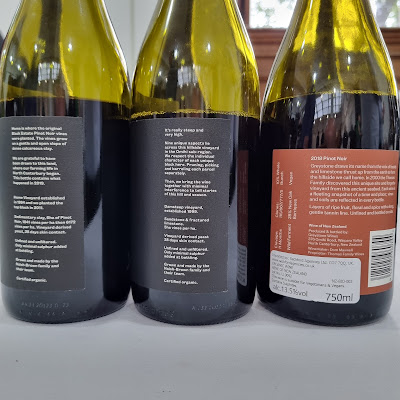
Below a selection of my best finds in the separate organic wine walkaround. Organic wines are making huge progress in quality, also in New Zealand.

Pinot Noir, Marlborough 2017
A surprise, smooth, long and mod complex. GBP 28
Score 93

Pinot Noir, Waipara, Canterbury 2018
Smooth long and complex, an amazing quality/price ratio. GBP 26
Score 93

Damsteep Pinot Noir Canterbury 2019
A top wine, perfect balance and complex. A harmonious wine. GBP 46
Score 94

Home Pinot Noir Canterbury 2019
Similar to previous wine, GBP 46
Score 94

Pinot Noir Block 3, Bannockburn, Central Otago 2020
Complex and long. GBP 62
Score 92

Pinot Noir Block 5, Bannockburn, Central Otago 2020
Similar to previous wine, GBP 62
Score 92


Tuesday, September 28, 2021

Organic wines of New Zealand

Most interesting event hosted by New Zealand Wines, expertly and safely organized by Sarah Shepherd at 67 Pall Mall in London. 

An informative way to spend a rainy morning, about 75 bottles to be tasted and some amazing surprises.

Overall, the quality of organic wines is increasing, not just in New Zealand but worldwide, as producers master the techniques. Still, a few wines today could not hide their rough edges, this is typical of less stable organic wines, and more work is to be done.

Compared to previous NZ tasting I noticed a marked improvement of their chardonnays. Sauvignon blancs remain the workhorse of NZ production and confirmed their world class quality also among this organic selection. 

Some exceptional gems stood out among the pinot noirs. Not quite the structure of Burgundy but these wines were full of complex and round fruit, they proved to be very long and, alas, relatively expensive, which I consider a sign of success in the market.

Below are my notes from a selection of all the wines tasted today.

chards and sauvignon whites...


BLENDS

An easy, fruity, smooth wine, good balance. RRP £24, Score 84.

Biodynamic, another easy typical pinot blanc, reminds me of Alsace brothers. RRP £25, Score 86.

SAUVIGNON BLANC

No sulphites added at all to this round and complex product. RRP £23, Score 88.

A typical sauvignon blanc, balanced and moderately complex, long. RRP £25, Score 89.

Strong citrus notes give a welcome freshness to this chardonnay, well balanced by vanilla in a long finish. RRP £25, Score 90.

CHARDONNAY

Another fresh chard with a unique sapid accent, which keeps on going... RRP £28, Score 88

Pineapple, vanilla, an elegant wine, complex and long, perfectly balanced. RRP £32, Score 92


... and reds: world class pinot noir

8. Felton Road pinot noir Cornish Point, Bannockburn, Central Otago 2020
Balanced and complex, needs a few years in the bottle to round a few rough edges. RRP £ 42, Score 88.

A great wine, smooth, long, powerful, complex in the extreme. Intense fruit meets elegance and structure and makes one dream of what the evolution in bottle might bring. RRP 46.50, Score 94

Another amazing wine from Felton Road, reveals immense potential in the nose and captivates the mind with a complex swirl of red fruits and chocolate in the mouth. Very long. RRP 42, Score 95

Similar to the preceding wine, but perhaps even more complex. RRP £60, Score 95

Another top pinot noir, spicy, opulent. RRP £55, Score 93

13. Burn Cottage Vineyard pinot noir, Central Otago, 2018
Similar in many ways to the preceding wine, RRP £ 53, Score 93

What an amazing tasting of pinot noirs! 


These days one is never too far away from a gel sanitizer


Organic production in NZ, image by Biogro


Friday, April 10, 2020

Film review: Résistence naturelle (2014), By Jonathan Nossiter, **

Synopsys

Ten years after the landmark wine documentary Mondovino, filmmaker Jonathan Nossiter returns to the subject, documenting the drastic shifts that have affected the industry in the time since. Natural Resistance follows four Italian winegrowers.

First is Giovanna Tiezzi lives in a converted 11th-century monastery, and grow grains, fruit, and wine in a way that links to their ancient heritage. She laments that much of Tuscany's vineyards have been bought up by foreigners, but then is proud that her region is a leader in quality vine cultivation.

Corrado Dottori is a refugee from industrial Milan, who inherited his grandfather's farmstead and tends to it as an expression of agricultural social justice. he studied capitalism at the Bocconi, he says, so as to criticize it better.

Elena Pantaleoni works her father's vineyards and strives to create a utopian reality.

Finally, Stefano Belloti, the controversial radical farmer poet, disrupts the long-established rules of farming from his avant-garde property in Piedmont. (Synopsys partly from IBMD.com)


Review

A lot of ideology in this hastily put together film, which is really only a compilation of Nossiter's chats with the above growers over some wine.

The title "resistance" recalls the fighters of World War II against fascism and nazism, and it is not by chance. Nossiter, inserts several clips of Mussolini speaking from a balcony and SS guards rounding up civilians in this movie, and contrasts them with the heroic organic farmers, his partisans of today.

The other word in the title is "natural". The film compares and contrasts it with "artificial". And artificial (made by man with material that exists in nature) is not the same as "synthetic" (made through synthesis, transforming elements that do not exist in nature). Of course, all wine is artificial, it does not exist in nature.

Several of the protagonists complain about the DOC rules being abstract, detached from the criteria for quality that was the original reason for being created. In this they are right, and it has long widely been accepted that many top-quality Italian wines do not have, seek or need DOC certification.

The film nostalgically recalls when, in Italy, but the numbers are similar in other European countries, 60% of the people lived and worked on farms. Now it is about 2-3% depending on how you count it. Of course, every country that modernizes and develops moves from the primary sector of the economy (agriculture) to the secondary (manufacturing) and on to the tertiary (services). This brings higher standards of living, I find it hard to argue one should go back to the happy past.

The speakers are generally critical of the European Union Common Agricultural Policy (CAP). They argue it is a conspiracy to hand agriculture to big multinational corporations. Let alone that in several countries, Italy among them, EU subsidies (managed by regional administrations) are often left unused because small farmers do not bother to claim them.

They also argue that hygiene checks are targeted to create problems for small wine producers while they close an eye on the big ones. I do not know about the accuracy of this sweeping statement but they do not provide any evidence.

I also noticed a bias when a farmer shows Nossiter the difference between rich organic soil and standard vineyard next to it. The organic soil is a dark rich color and fluffy texture while the standard soil is hard and grey. But Belotti digs his organic sample near a plant and the other one on a pathway where constant traffic is expected to compact the soil. A careless test at best.

In sum, this film is more of an emotional call to arms than an analysis of the undoubted biological benefits of organic farming.

Saturday, April 4, 2020

Film review: L'Esprit du vin (2011) by Olympe and Yvon Minvielle **

Synopsys

A film sponsored by Château Lagarette, a biodynamic producer in Bordeaux.

A dozen or so biodynamic wine-growers express their vision of the present and make proposals for the future.

They ask eminently social and even political questions: What food? How could humanity restore the ideal of living together?

I hope this review can help the reader make up his own mind on this subject.


Review

This film is an all-out passionate defense of biodynamic viticulture. I say defense because most of the interviewees talk as if they are under siege, as if the evil forces of modernity are out to extinguish the feeble flame of tradition. No alternative point of view is presented in the film. If you want to hear alternative voices, skeptical or critical of biodynamic wine, you have to look elsewhere.

Clearly, the growers interviewed are very passionate about their wine, but often they get carried away. Just a few pearls from their statements. A basic theme of the film is a high level of hostility toward "technology": there is "technological" wine, which is artificial and then there is biodynamic wine, which is natural. Oddly, little attention is paid to organic wines, although biodynamic certification requires a wine to be organic to begin with.

A couple of speakers identify "technological" wines as the result of American influence and specifically the work of Robert Parker, while, on the contrary, "Europe" is the custodian of genuine winemaking. Well, Parker has nothing against biodynamic wines and actually promotes it. And, of course, there are lots of American biodynamic producers and in fact the USA is the biggest biodynamic farming producer in the world.

One speaker argues that biodynamic vineyards are better equipped to resist the negative radioactive impact of Chernobyl, thus lumping together as if it was a dogmatic truth a whole host of questionable assumptions.

A major problem for me is when, as several speakers repeat in this film, the argument is put forward that what is important in biodynamic wine is NOT the result, but the relationship between man and nature, a new philosophy of daily life. Assuming the latter is somehow better served in biodynamic farming, for me the end result, ie good and healthy wine, IS WHAT MATTERS.

Technology, a word that is often repeated with a grimace by many interviewees, destroys the relationship man and nature, farmer and vineyard. Biodynamic preparations restore the correct energy flows! A corollary of this argument is the open hostility of one speaker to established wine associations such as the Masters of Wine. In his view, these associations have been created to serve technology against the natural traditions of wine.

One speaker is very honest when he says biodynamic farming is like a religion: you can not demonstrate it, you can only believe it. Another one compares it to acupuncture: not scientifically proven, but many believe it anyway. Not surprising that biodynamic farmers also accept homeopathic principles, as they use extremely diluted solutions in some of their preparations.

A quirky claim toward the end of the film is that biodynamic wine is especially appreciated by women! Maybe so, as a woman grower claims to have produced a "concert wine" in her biodynamic vineyard because both wine and music share a spirituality for people to appreciate.

If you already believe in biodynamic farming this film will make you feel really good. If you are trying to understand more, it will give you only half the picture.

For a different view on biodynamic farming, watch this video, (in Italian).

For a wise and cool view of the subject, read Jancis Robinson, one of the world's most respected authorities.

You can watch the film reviewed here on Youtube.